


Page 80 - Post-traumatic stress disorder in adults with mild intellectual disability: Screening, assessment, and brief intensive EMDR therapy
P. 80
Chapter 4
Each participant had at least one steady professional caregiver involved
during the study period. The exclusion criteria were high suicidal risk and
excessive alcohol/drug use which would make it difficult for a participant
to attend a therapy sober.
Participation in this study was voluntary. The study protocol was approved by
the Medical Research Ethics Committee of the East Netherlands (reference
number: 2020-6967- NL75909.091.20). All clients interested in participating
in the study received an information letter. Nine participants provided
written informed consent to participate in this study. Because of a lack of
capacity to provide written consent, legal representatives provided consent
for three participants. However, these three participants still provided
verbal consent. This resulted in an initial sample of 12 participants. One
participant dropped out on the second day of EMDR therapy because he felt
overwhelmed by the emotional stress and refused to further participate in
this study. Six women and five men aged 21–65 years, participated in this
study. Table 1 presents the characteristics of the participants.
Measures
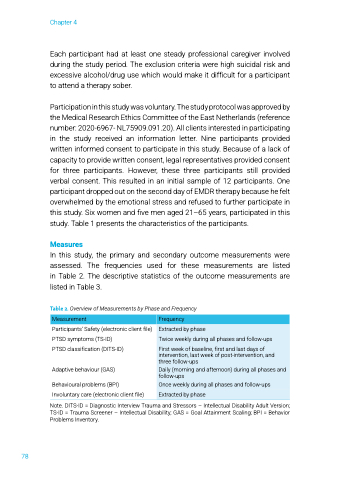
In this study, the primary and secondary outcome measurements were
assessed. The frequencies used for these measurements are listed
in Table 2. The descriptive statistics of the outcome measurements are
listed in Table 3.
Table 2. Overview of Measurements by Phase and Frequency
Measurement Participants’ Safety (electronic client file) PTSD symptoms (TS-ID) PTSD classification (DITS-ID) Adaptive behaviour (GAS) Behavioural problems (BPI) Involuntary care (electronic client file) Frequency
Extracted by phase
Twice weekly during all phases and follow-ups
First week of baseline, first and last days of
intervention, last week of post-intervention, and
three follow-ups
Daily (morning and afternoon) during all phases and
follow-ups
Once weekly during all phases and follow-ups
Extracted by phase
Note. DITS-ID = Diagnostic Interview Trauma and Stressors – Intellectual Disability Adult Version;
TS-ID = Trauma Screener – Intellectual Disability; GAS = Goal Attainment Scaling; BPI = Behavior
Problems Inventory.
78


