


Page 46 - Post-traumatic stress disorder in adults with mild intellectual disability: Screening, assessment, and brief intensive EMDR therapy
P. 46
Chapter 2
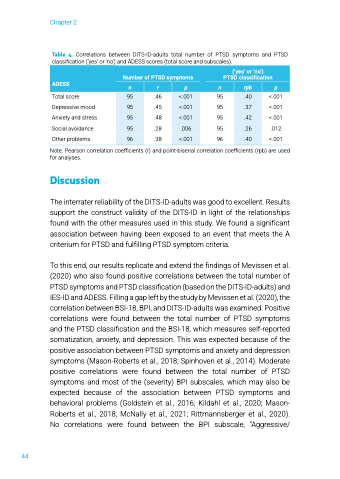
Table 4. Correlations between DITS-ID-adults total number of PTSD symptoms and PTSD
classification (‘yes’ or ‘no’) and ADESS scores (total score and subscales).
(‘yes’ or ‘no’)
PTSD classification
ADESS
Number of PTSD symptoms
n r p n rpb p
Note. Pearson correlation coefficients (r) and point-biserial correlation coefficients (rpb) are used
for analyses.
Total score 95 .46 <.001 95 .40 <.001
Depressive mood 95 .45 <.001 95 .37 <.001
Anxiety and stress 95 .48 <.001 95 .42 <.001
Social avoidance 95 .28 .006 95 .26 .012
Other problems 96 .38 <.001 96 .40 <.001
Discussion
The interrater reliability of the DITS-ID-adults was good to excellent. Results
support the construct validity of the DITS-ID in light of the relationships
found with the other measures used in this study. We found a significant
association between having been exposed to an event that meets the A
criterium for PTSD and fulfilling PTSD symptom criteria.
To this end, our results replicate and extend the findings of Mevissen et al.
(2020) who also found positive correlations between the total number of
PTSD symptoms and PTSD classification (based on the DITS-ID-adults) and
IES-ID and ADESS. Filling a gap left by the study by Mevissen et al. (2020), the
correlation between BSI-18, BPI, and DITS-ID-adults was examined. Positive
correlations were found between the total number of PTSD symptoms
and the PTSD classification and the BSI-18, which measures self-reported
somatization, anxiety, and depression. This was expected because of the
positive association between PTSD symptoms and anxiety and depression
symptoms (Mason-Roberts et al., 2018; Spinhoven et al., 2014). Moderate
positive correlations were found between the total number of PTSD
symptoms and most of the (severity) BPI subscales, which may also be
expected because of the association between PTSD symptoms and
behavioral problems (Goldstein et al., 2016; Kildahl et al., 2020; Mason-
Roberts et al., 2018; McNally et al., 2021; Rittmannsberger et al., 2020).
No correlations were found between the BPI subscale, “Aggressive/
44


